



Guide
First Adult Tricycle Buying Guide
Choose your first adult tricycle by checking rider fit, storage, weight limits, gears, brakes, assembly, and service before buying.
We research everything we recommend. When you buy through our links, we may earn a commission. Learn more
Guide
A mirror should support a usable observation routine on the actual trike. A helmet or eyewear-mounted mirror moves with the rider's head, while a.

Updated · 11 min read
A mirror should support a usable observation routine on the actual trike. A helmet or eyewear-mounted mirror moves with the rider's head, while a handlebar mirror moves with the steering assembly and its mount. Those differences affect fitting, adjustment, storage, and what the rider needs to learn. Neither category is a universal winner, and adding two poorly fitted mirrors does not automatically improve the arrangement.
This guide compares the practical selection process. It does not prescribe one mirror position, guarantee a field of view, or replace the need to observe traffic appropriately. Follow the vehicle, mirror, helmet, and eyewear instructions. If a proposed attachment is not supported, choose another documented arrangement rather than modifying protective equipment or a steering component simply to create a convenient mounting point.

Describe the route situations in which a rearward view is useful and the normal position used on the trike. Upright and recumbent riders may have different sight lines and accessory space. A mirror that worked on a previous bicycle can be a useful reference, but it is not proof that the same product will suit the current vehicle or posture.
Map the existing controls and the normal head movements before buying. A mirror should not obscure a brake lever, display, forward view, or another necessary task. The handlebar-layout guide helps establish the complete fitted arrangement on a recumbent. The general mirror guide addresses installation questions beyond this category comparison.
Keep any individual vision or movement limitation separate from product marketing. If a health issue affects observation, obtain appropriate professional advice and a suitable individual assessment. This article cannot prescribe a mirror as a treatment or guarantee that it compensates for a particular limitation. The equipment decision should remain grounded in demonstrated usability and the rider's actual needs.
A wearable mirror's view changes with the position of the head and the way it is mounted. A vehicle-mounted mirror's view depends on its attachment and the steering arrangement. These are practical differences to explore while stationary. Do not assume that a view seen in one parked position remains identical through every ordinary movement.
Ask the maker to explain the intended adjustment and use. Product-specific instructions can differ even within the wearable or handlebar category. A mirror clipped to glasses is not necessarily fitted like one using a helmet adapter. Likewise, a bar-end interface and a clamp around a handlebar are different mounting systems.
Avoid treating a mirror's size as the only comparison. Mount stability, supported interface, adjustment access, clearance, and the rider's ability to interpret the view all matter. A larger reflective surface on an unsuitable connection may be less useful than a smaller documented setup that fits the complete vehicle and equipment.
If considering a helmet attachment, identify the approved mirror mount and helmet requirements. Do not drill, cut, compress, or otherwise alter a helmet through an unapproved method. A convenient adhesive surface does not establish that the helmet maker permits an attachment. The helmet guide covers maintaining the intended fit and condition.
Try the complete arrangement with the helmet adjusted normally. The mirror should not require loosening straps or changing the protective equipment's position merely to produce a view. If the attachment affects fit or ordinary movement, resolve that with the relevant makers or select another supported system.
Record the exact adapter and installation instructions. A mirror transferred to a new helmet should be reassessed rather than attached from memory. Similar shapes can conceal different materials or construction. The previous installation's success does not authorize the same method on every replacement helmet.
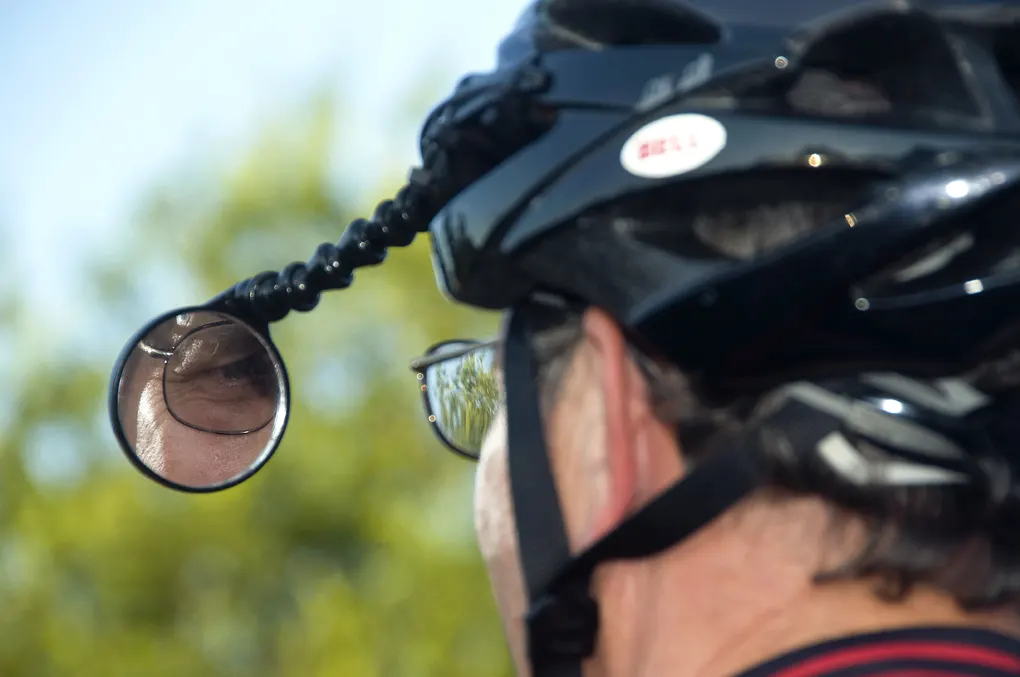
An eyewear mirror needs a suitable frame interface and a fit that remains usable with the mirror attached. Take A Look's instructions provide an example of a specific attachment method and adapter arrangement. That method should not be generalized to every frame or mirror. Confirm the actual product combination before relying on it.
Use the intended glasses and helmet together in a stationary session. Observe whether the mirror changes the frame position, creates pressure, or interferes with head movement. The eyewear guide covers lens and frame selection. A comfortable pair of glasses is not automatically a suitable mount for additional equipment.
If the mirror will be moved between several pairs of glasses, ask whether the maker supports that routine and how fit is checked each time. A different temple shape can change both attachment and view. Keep each supported arrangement documented instead of assuming one adjustment works across all frames.
For a vehicle-mounted mirror, identify the exact clamp or bar-end requirements and compare them with the installed handlebar and grip. An opening at the end of a bar is not a universal socket. Dimensions, material, internal construction, and manufacturer permission can all matter. The grip compatibility guide addresses related interface questions.
Do not remove a plug, grip, or control before establishing the intended procedure and replacement requirements. Some equipment may need a competent installer or a specific part. A product listing saying universal does not resolve those questions. Ask for confirmation against the actual bar and vehicle rather than a general adult-tricycle category.
Include the complete steering movement in the fit assessment. A mirror may clear the rider while straight ahead but contact a seat, fairing, wall, or accessory during a turn or storage procedure. The mounting arrangement should preserve the vehicle's intended range without bypassing a stop or rerouting controls casually.
Use the same seat setup, ordinary clothing, helmet, eyewear, and loaded vehicle for each candidate. Secure the trike appropriately and follow the product instructions for adjustment. Record what is visible from the normal position and which movements are needed to obtain it. Do not turn a stationary view into a claim about every moving traffic situation.
A reflection that requires an awkward posture may indicate an unsuitable position or product. Ask the supplier or installer about supported adjustments before accepting that posture as normal. The fit guide explains why equipment should work with the intended riding position rather than forcing a new one solely for an accessory.
Avoid a risky road trial with an unresolved mirror setup. Learning to interpret the view should begin in an appropriate setting and within the rider's capability. A mirror supports observation; it does not remove the need for suitable route choices, awareness, and compliance with current local traffic requirements.

For a handlebar mirror, operate the intended controls while stationary and inspect nearby clearance. A clamp should not occupy a position needed by a brake lever, grip, cable, or hand. A mirror arm should not become an obstacle to mounting. On a recumbent, the relationship with a side-mounted control can differ significantly from an upright bicycle.
For a wearable mirror, include the hood and glasses arrangement used in wet or cool weather. Fabric can contact the mirror or change its position. The rainwear guide explains why each item should be evaluated as part of the full outfit. A fit that works without a hood may not describe an ordinary rainy commute.
If a conflict appears, change the supported accessory arrangement or product rather than altering unrelated safety equipment. Do not loosen a helmet, move an unidentified brake component, or tie fabric to a control to make the mirror fit. Compatibility should be resolved directly, not through a chain of improvised compensations.
A handlebar mirror can add to the trike's outer dimensions. Measure the actual installed outline and check the gates, storage entrances, and parking spaces you use. The clearance guide covers the complete vehicle. A quoted trike width may not include the mirror or other accessories shown in a product image.
If the mirror has an intended folding or removal feature, learn its procedure and any recheck before riding. Do not assume every mirror may be bent inward for storage. Repeatedly forcing an adjustable joint through an unintended movement can create a different maintenance problem. Ask the maker which operations are part of normal use.
A wearable mirror has a different storage task. Keep it protected through the product's intended method and account for it when removing the helmet or glasses. It can be damaged or lost during an ordinary stop even though it does not expand the parked trike's width. Compare these routines rather than treating one category as maintenance-free.
Use the mirror maker's procedure and any applicable vehicle specifications. A mirror that loosens repeatedly deserves assessment of the actual mount and compatibility. Do not keep tightening an unfamiliar fastener without its instructions. The torque guide explains why identifying the component and specification comes before selecting a force.
Check the arrangement after transport, an impact, or an accessory change. A view that seems different may result from the seat, handlebar, mirror, or wearable equipment moving. Record what changed rather than adjusting several parts at random. A reference photograph can help communicate the normal setup without certifying its current condition.
Stop in a suitable location before making an adjustment during a trip. Do not try to repair a loose mirror while riding through traffic. If the product cannot be retained through its intended method, end or change the outing as appropriate. An accessory problem should remain a manageable stopped task.

A claim about a wide view, low vibration, or universal fit should be read with its conditions and supported interfaces. It is not a guarantee for every trike or rider. Compare exact models and installation requirements rather than ranking the entire wearable and handlebar categories by one advertisement.
This article does not measure optical distortion, field of view, vibration, or detection distance. If a particular performance characteristic matters, seek the relevant product documentation and an appropriate fitting opportunity. A confident reviewer statement without a described method should not replace that process.
Keep the purchase record and instructions. If replacing the mirror with a similar-looking product, repeat the compatibility check. Small changes in clamp dimensions, adapter shape, or adjustment mechanism can matter even when the broad name remains familiar. The ownership-file guide provides a place to retain that information.
Imagine a recumbent rider whose handlebar mirror gives a usable parked view but makes a narrow storage entrance awkward. The rider compares a supported inward-folding arrangement with a wearable option, using the same helmet, glasses, and seated position. The decision includes storage, control clearance, and the learning routine rather than only the image size in the mirror.
Another rider may find a wearable mirror convenient but discover that it displaces the intended glasses when a rain hood is worn. That does not prove the whole category unsuitable for everyone. It identifies a specific combination requiring a different supported product or arrangement. The useful conclusion is a documented fit for the actual routine, not a universal category ranking.
After selecting a setup, revisit it when the surrounding equipment changes. A new helmet, grip, headrest, bag, or fairing can alter compatibility or the view. Keep the mirror as part of the complete pre-ride check and observation routine. Its value comes from correct, consistent use on the fitted vehicle.
Write down how each candidate is put into use, adjusted while stopped, checked before departure, stored, and restored after transport. A wearable option may simplify the parked trike's outline while adding a task every time glasses or a helmet are removed. A handlebar option may remain with the vehicle while needing clearance through a doorway. These are ownership differences, not evidence that one category is inherently superior.
Use an equal stationary comparison. Keep the same seat position, ordinary clothing, helmet, glasses, and cargo. Follow the product's fitting method and record the view available from the normal position. Note any movement needed and any interference with controls or the rider's access. A mirror that appears clear only after leaning into an unusual posture needs further assessment rather than an optimistic check mark.
Separate mounting certainty from visual preference. A rider may like the apparent image in a product whose attachment has not been approved for the bar or helmet. That candidate remains unresolved. Conversely, a documented mount can fit correctly while giving a view the rider cannot use comfortably. Both conditions need to be satisfied before the arrangement is ready for an appropriate introduction.
Consider a household that shares a trike. A handlebar mirror may need a permitted adjustment between riders, while a wearable mirror may stay with each person's supported equipment. The handover record should identify what changes and who checks it. Do not assume that leaving the same mirror physically attached leaves the same useful view for a different seated position.
Keep an adjustment problem from becoming a tightening experiment. If a joint moves repeatedly, record the exact mount and circumstances and ask the maker or installer to assess it. The cause may involve compatibility, condition, installation, or another issue. Repeatedly applying more force without the applicable procedure can obscure the problem and damage the interface.
At the end of a trial, state the evidence honestly. A suitable parked view and a short appropriate introduction support a limited preference for the actual configuration. They do not measure vibration resistance or guarantee traffic detection. The useful decision records the supported product, its installation, the rider's routine, and the conditions that require another check after equipment changes.

Compare what happens when the rider parks for shopping or a rest. A wearable mirror may need protected storage with the helmet or glasses, while a vehicle-mounted product may remain exposed or use an intended removal feature. Follow the actual instructions and keep small adapters identified. A mirror should not be left balanced on a seat or transferred casually to a different frame because its original mounting point is temporarily unavailable.
Before riding again, restore the supported arrangement and check the view while stationary. Do not assume that reattaching a product in approximately the same location recreates the previous adjustment. This stop routine can be a meaningful difference between otherwise suitable candidates, particularly for a rider making several short errands rather than one continuous ride.
Research-based comparison guide, 15 October 2026. No optical field, vibration, or hands-on mirror testing was performed.
Guide
Choose your first adult tricycle by checking rider fit, storage, weight limits, gears, brakes, assembly, and service before buying.

Guide
Learn how to compare adult electric tricycles for control, fit, batteries, braking, transport, and ownership support.

Guide
Understand the leg and hip muscles used when pedaling a tricycle, plus how fit, resistance, and electric assistance change the effort.