
Guide
First Adult Tricycle Buying Guide
Choose your first adult tricycle by checking rider fit, storage, weight limits, gears, brakes, assembly, and service before buying.
We research everything we recommend. When you buy through our links, we may earn a commission. Learn more
Guide
Measure tricycle width, gates, turns, barriers, storage access, and loaded accessories before choosing a vehicle or relying on a route.

Updated · 12 min read
A tricycle can have the right seat height and still be too wide for the places you need to use it. Gates, bollards, garage doors, trail barriers, and the space beside parked cars are part of the fit. The important measurement is the complete operating envelope, including mirrors and cargo, rather than the wheel width printed in a product headline.
This guide helps you measure the vehicle and its route, evaluate turns and access restrictions, and document a workable daily journey. It does not declare any road legally accessible or recommend riding through a gap with almost no margin. Those decisions depend on local rules, the specific site, and the rider's control.

Overall width describes the widest part of the complete vehicle. Wheel track describes the distance between paired wheel contact points or centers, depending on the specification. Handlebar width describes another component entirely. These values can differ, and sellers sometimes use similar labels without explaining where the tape measure was placed.
Ask for a diagram or written definition when dimensions determine whether the vehicle will enter your home. Record width, length, and height in the riding configuration. Then note accessories that extend beyond the original shape. A mirror, support handle, basket, or flag mount can become the widest or tallest part.
Measure the actual configured vehicle when possible. If you are buying remotely, request measurements from the dealer and leave room for uncertainty. A nominal width rounded to a convenient number should not be used to justify a gap that is only slightly larger. Your first-tricycle buying checklist should include access dimensions alongside rider fit and braking controls.
An opening is not always as wide as the distance between its upright posts. Hinges, handles, stop blocks, vegetation, and protruding bolts may reduce the usable corridor. Measure at the heights occupied by wheels, basket, and handlebars. A gate that clears the tires can still strike a mirror.
Check whether a door opens fully and whether you can hold it there while controlling the tricycle. A spring-loaded door or an uneven threshold changes the task. If opening the gate means letting go of the vehicle on a slope, the measured width alone has not solved the access problem.
Write down the measurement and the obstruction rather than relying on a photograph alone. A photograph shows context, but perspective can make a narrow gap appear generous. Include the surface before and after the entrance: mud, loose gravel, or a sharp drop may make an otherwise wide opening unsuitable.
A tricycle that fits through a gate in a straight line may not make the turn immediately beyond it. The frame has length, rear wheels follow different paths, and the basket may swing close to a wall. Think of the maneuver as a swept area, not one rectangle sliding through a doorway.
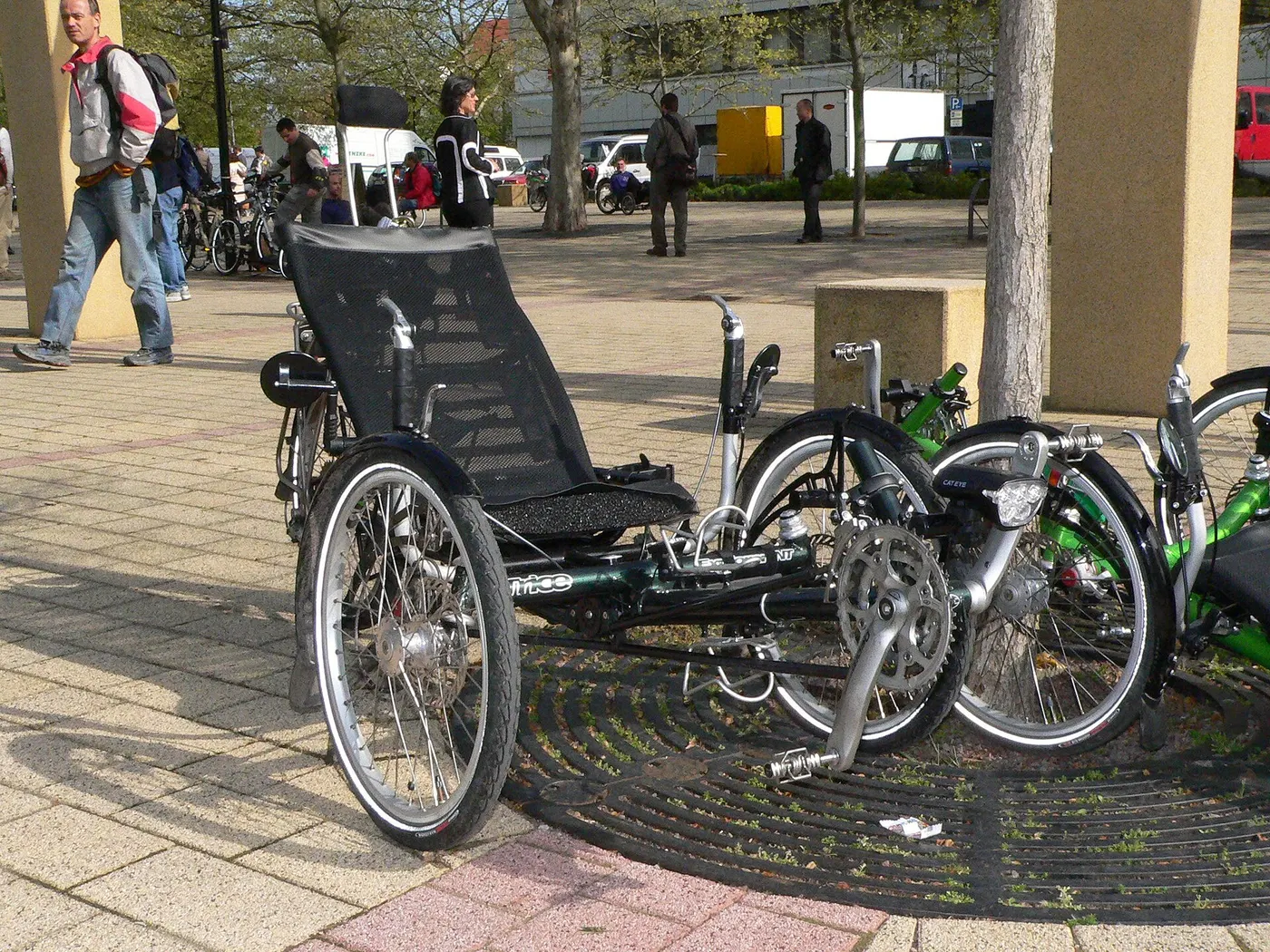
Measure the approach space, the opening, and the receiving space. If there is a right-angle turn, note how far the vehicle can move forward before it must steer. Consider the rider as well: elbows, feet, or a recumbent pedal arc may extend beyond the static frame outline during normal operation.
A safe demonstration with the actual tricycle is more persuasive than a seller saying it has a small turning circle. Keep the trial slow and unloaded, with soft markers and no traffic. Stop before contacting a wall. Do not force a handlebar or lift a wheel to make the vehicle fit. Use the turning and camber guide to understand why a cramped turn becomes harder on an uneven surface.
Begin at the storage location and follow the entire proposed journey on foot where practical. Include leaving the building, crossing a driveway, joining a path, parking at the destination, and returning. The return may have different turns, slopes, or gates even when the road names are identical.
For each constrained section, record the narrowest clear width, surface, visibility, traffic or pedestrian interaction, and an alternative. Mark locations that require permission or legal clarification. A route application can identify paths, but rarely confirms current barrier spacing or whether a gate is locked after business hours.
Use three categories: suitable after a controlled trial, unresolved pending inspection, and unsuitable for this vehicle or rider. Do not turn a doubtful section into an acceptable one merely because every other part of the journey looks good. One inaccessible entrance can prevent the trip, especially when you return tired or with cargo.
Bollards often create a short, narrow channel. Staggered barriers may require a tight sequence of turns rather than a straight passage. A tricycle's paired wheels and length can make that sequence difficult even where a two-wheel bike moves through easily. Assess the complete arrangement from both sides.
Look for lawful alternative access provided for wider cycles, mobility devices, or maintenance vehicles. Do not remove posts, ride around a barrier through landscaping, or assume that a gap intended for another use is open to your vehicle. Contact the path operator if access information is unclear.
If an accessible gate needs a key or arrangement, establish that before relying on the route. Record operating hours and what happens if the gate is unavailable. A backup route should be realistic for your range and control, not just a line on a map. Wider infrastructure can be worth a longer journey when it avoids repeated stressful maneuvers.
An opening only slightly wider than the vehicle leaves little room for normal steering variation. Pavement edges can be fragile, and a wheel may not track exactly where you intended. The useful margin depends on the surface, speed, sight lines, and your familiarity; there is no universal spare-width number that makes every passage safe.
Allow space for other people rather than treating the entire path as yours. On a shared path, slow early and wait at a broad section when necessary. A pedestrian using a cane, stroller, or wheelchair may also need a predictable corridor. Do not ask them to squeeze against an edge while you keep moving.
When passing is unsuitable, stop and communicate calmly. Choose a position where all wheels remain on sound ground and where the tricycle will not roll. A bell or voice can announce your presence, but neither creates clearance. Avoid an aggressive horn that startles someone into the wheel path.
For an apartment or workshop, measure the route inside the building as carefully as the entrance. An elevator may have enough floor area but a narrow door and no room to turn. A corridor may contain furniture, fire doors, or a corner that cannot be negotiated without moving the vehicle awkwardly.
Check building permission and preserve emergency exits. Storage should not depend on blocking a corridor or propping open a fire door. An electric tricycle also needs an approved charging location; space for the frame is not the same as a suitable place for its battery and charger.
Use cardboard or tape to mark the proposed footprint, without creating a trip hazard. Include the room needed to approach, operate the parking brake, and remove the battery if applicable. The storage and transport guide covers handling weight and loading decisions that dimensions alone cannot settle.

After installing a mirror, wider basket, phone mount, or support accessory, repeat the relevant measurements. A folding mirror might solve storage width but needs to be returned to a useful position before riding. A loose accessory that rotates during a turn can create a changing envelope.
Measure a loaded basket as well as an empty one. Bags may bulge past its sides, and a shopping item may project beyond the rim. Do not use the original vehicle width while carrying an object that is wider than the tricycle. Secure the load and preserve the manufacturer's restrictions.
Keep a configuration note with the vehicle: which accessories were fitted during the route trial, where the mirrors were positioned, and whether cargo was present. This makes later changes visible. It also helps a household sharing the tricycle understand why one particular entrance requires the same setup every time.
Some folding designs reduce length but leave the paired-wheel width largely unchanged. Others have more extensive folding or removal steps. Compare the actual folded envelope with the restriction you are trying to solve. A short folded length is irrelevant if the doorway is too narrow for the axle.
Consider where you would fold and unfold. The location should be level, spacious, and free of traffic. You need access to the latch and a way to support the weight without pinching cables or fingers. A plan that requires folding in a live doorway during every trip can become impractical quickly.
Do not ride a partly folded vehicle through a tight passage. Follow the manufacturer's method for moving it in the folded state. Our folding-tricycle guide provides a full measurement and handling worksheet, including the difference between folded size and genuine portability.
The existence of a painted bike lane does not establish that every part is wide enough for your tricycle. Drainage channels, parked vehicles, and debris can reduce usable space. Equally, a wide footpath is not automatically a lawful riding route. Check current rules with the relevant transport or path authority.
Describe the vehicle accurately when asking: conventional or electric, approximate width, any assistance classification, and the exact path or road segment. Avoid asking only whether “bikes” are permitted if the facility has restrictions on motor assistance or vehicle dimensions. Keep the answer and its date with your route notes.
Where a road layout repeatedly puts a wheel near an unsafe edge, seek a different route or instruction from a qualified local cycling organization. Do not improvise a position based solely on advice from an international article. This guide concerns measurement and planning, not a universal legal lane-position rule.
| Item | What to record | Why it matters |
|---|---|---|
| Complete vehicle | Width, length, height, fitted accessories | Establishes the real envelope |
| Entrance | Clear width at relevant heights, threshold, door behavior | Finds obstructions hidden by nominal opening size |
| Turn | Approach and receiving space, wheel paths | Checks more than straight-line fit |
| Path barrier | Gap, sequence of turns, hours, alternative | Prevents an inaccessible route assumption |
| Destination | Parking approach, secure anchor, return exit | Makes the entire trip workable |
Take the worksheet to a dealer rather than asking them to guess from a doorway photograph. Where possible, arrange a demonstration or rental using the same vehicle size. Written dimensions are still useful, but the practical trial should include the person who will operate the tricycle, not only an experienced salesperson.
A useful trial begins with retrieving the tricycle, progresses through the access route, and ends with putting it away. Time pressure, doors, locks, and carrying belongings can change the task substantially. Repeat the routine without a cargo load first, then with a modest approved load if appropriate.
Check whether you can perform each step independently if that is your intended use. Help available on demonstration day may not exist on a rainy weekday. If assistance is part of the plan, define exactly which steps need it and whether the arrangement is dependable.
Buy for a repeatable routine with spare room, not for a one-time maneuver achieved by rotating mirrors, lifting an axle, and asking someone to hold every door. A narrower or differently configured tricycle may suit your access better, but compare rider fit and handling at the same time. Width is a necessary filter, not the whole purchasing decision.

Suppose a tricycle's quoted width is smaller than an apartment door opening. That sounds promising, but the route also includes a short corridor and a right-angle turn into storage. The first question is whether the quoted width includes mirrors and basket. The second is whether the door's handle and closer reduce the opening. The third is whether the receiving corridor permits the rear wheels and frame to complete the turn. All three need an answer.
Mark the vehicle's complete dimensions on a worksheet and draw the approach in a simple floor plan with actual measurements. Do not estimate a turning radius from wheelbase alone; steering limits and the full shape matter. A physical trial with the actual model is preferable where access determines the purchase. Use permission and controlled handling, with no other residents forced into a narrow passage during the test.
If folding is needed at the door, identify the level space for the operation, where the battery or bag will be placed, and how the folded vehicle is moved. A successful passage made by three people lifting and rotating the tricycle should be recorded as an assisted maneuver, not evidence that you can perform it alone. If independent access is essential, that distinction can settle the purchase.
Parked cars, delivery bins, cafe furniture, vegetation, and temporary works can change usable width. A route audit should therefore identify sections vulnerable to obstruction and an alternative. A gap that is normally broad may become unusable at school pickup time or on a market day. Check the times at which you actually intend to ride.
Do not plan to brush past a parked vehicle because the tape-measured gap is slightly wider than the tricycle. Doors can open, people can step into the corridor, and a wheel may need correction around debris. Your route decision must include those interactions as well as static dimensions. A wider parallel street or a different destination entrance may be more practical.
Recheck routes after storms, construction, or seasonal growth. You do not need to repeat every measurement on every trip, but remain alert to changes. Record a newly difficult section before it becomes a routine you try to overcome with speed or sharper steering. The route note should help you choose an alternative early.
When contacting a path operator, provide the specific entrance, the tricycle's complete dimensions, whether it is electrically assisted, and the intended direction of travel. Ask about current permissions and any designated alternative gate. A general question about bicycles may receive a general answer that does not resolve a wider vehicle's access.
Keep the reply with its date and any conditions. Do not interpret an accessible-looking maintenance gate as permission to use it without authorization. If an operator offers an arrangement, confirm the practical details: opening hours, keys, contact method, and what happens if the gate is closed unexpectedly. This is route planning rather than a universal statement about your rights.
A clear question also helps separate an infrastructure barrier from a rider-skill issue. More practice cannot shrink an axle or create missing receiving space. Where the route fails a physical or permission requirement, mark it unsuitable until the requirement changes. That keeps the purchase and daily ride grounded in what can actually be done.
Research-based guide. The measurement worksheet and route categories are editorial planning tools; no clearance trials or legal access determinations were performed for a specific location.
Guide
Choose your first adult tricycle by checking rider fit, storage, weight limits, gears, brakes, assembly, and service before buying.

Guide
Learn how to compare adult electric tricycles for control, fit, batteries, braking, transport, and ownership support.

Guide
Understand the leg and hip muscles used when pedaling a tricycle, plus how fit, resistance, and electric assistance change the effort.