
Guide
First Adult Tricycle Buying Guide
Choose your first adult tricycle by checking rider fit, storage, weight limits, gears, brakes, assembly, and service before buying.
We research everything we recommend. When you buy through our links, we may earn a commission. Learn more
Guide
Understand adult tricycle turning and road camber, separate surface effects from faults, and practice with suitable speed, space, and cargo.

Updated · 12 min read
An adult tricycle can stand on three wheels while still needing careful control in a corner or across a sloping road. Those are different kinds of stability. If your first ride feels as though the handlebars are pulling toward the gutter, the road surface may be influencing the whole vehicle. If the pull appears on level ground as well, a mechanical inspection belongs ahead of more practice.
This guide explains how to separate those situations, build a useful practice session, and decide when a route is unsuitable. It applies mainly to conventional, non-tilting tricycles. Steering layouts, tire arrangements, cargo limits, and manufacturer instructions vary. The examples are planning exercises, not tested speed limits for any particular model.

A bicycle normally leans as it turns. A conventional tricycle generally keeps its frame supported by three separate tire contact areas. The rider therefore cannot rely on the same instinctive countersteering and lean that worked on a bicycle. The steering input turns the vehicle, while the arrangement of rider, frame, and cargo determines how weight is supported.
During a corner, the vehicle needs lateral force to change direction. As speed rises or the corner tightens, that demand rises. A wheel can become lightly loaded before the rider expects it. Three wheels do not remove the possibility of a rollover. The practical response is to reduce speed before the bend and preserve a wide, predictable line within the space you are entitled to use.
Avoid memorizing a single maximum turning speed. A turn on smooth, level pavement with an empty basket differs from one with a pothole, a cross-slope, and a shopping load. Even the same rider and tricycle can behave differently between those situations. Use the maker's operating instructions and begin with generous margins rather than testing the tipping threshold.
Road camber is the slope across the direction of travel. A crowned street often slopes from its center toward its edges so water can drain. A driveway may slope in more than one direction. A path can change cross-slope at every access ramp. These surfaces affect the relationship between the rider's position and the three wheels.
Notice which side is lower before entering the section. Look at the road shape, drainage edge, and how parked vehicles sit, but do not assume those clues prove the exact slope. A quiet walking inspection can be more useful than a mapping application. The problem is often a short transition rather than the entire street.
When one wheel drops into a gutter while the others remain higher, the tricycle may feel as though it needs continuous correction. That feeling does not mean you should hold a rigid arm position and force the bike along at your normal pace. Slow early, maintain gentle control, and choose another line or route if adequate clearance is unavailable.
Find a broad, level, traffic-free place for the comparison. Inspect tire condition and inflation using the correct specifications, make sure cargo is removed or secured, and check that nothing drags against a wheel. Follow the pre-ride maintenance checklist before trying to diagnose steering through riding.
Ride slowly with both hands on the controls. Do not release the handlebars as a tracking test. Note whether the steering feels different on the outward and return directions across the same surface. A change associated with the slope is a useful observation, but it is not a professional alignment assessment. Unequal brake drag, damaged components, or incorrect assembly can coexist with road camber.
Stop if the vehicle jerks, a wheel wobbles, a brake rubs strongly, or the steering binds. Photograph the relevant parts and describe the conditions to a qualified mechanic or the manufacturer. A concise report such as “pulls left on this level section in both directions with no basket load” is more useful than “the trike feels wrong.”
Choose a permitted area with level pavement, clear sight lines, and enough room to stop without reaching an obstacle. Avoid a parking lot that only appears empty but has active driveways. Set soft markers well outside the wheels' intended path. Hard cones, curbs, and parked vehicles should not become the first boundary you learn to judge.
Start by riding straight, slowing smoothly, and stopping. Then make broad arcs in both directions. Work on looking where the entire vehicle should go rather than staring at the front tire. The rear wheels travel on different paths from the front wheel, so a successful front-wheel line alone does not guarantee clearance.
Keep early sessions short enough that fatigue does not change your grip or attention. If you need someone present, agree on a simple stop signal and have them stand outside the riding line. They should not pull a moving handlebar or try to steady a tricycle by grabbing the basket. A quiet stop and reset is preferable to assistance that introduces another steering force.
Approach at a pace that lets you complete the turn without abrupt braking. Look through the bend, reduce speed on the straighter approach, and move the controls gradually. This sequence leaves more attention for wheel clearance and surface changes. Charging into a corner and then grabbing a lever is an avoidable complication.
Use your model's guidance on body position. Instructions differ, and blanket advice to remain perfectly upright or lean dramatically can be misleading. For example, the Lectric XP Trike2 manual describes slowing and a slight lean toward the turn. That is a model-specific instruction, not permission to carry more speed or imitate the posture on every tricycle.
If a wheel feels unusually light, the steering suddenly changes, or the surface is worse than expected, reduce the demands rather than adding sharper input. Stop where safe and reassess. Do not intentionally lift a wheel to learn the limit. The general safe-riding guide covers the wider practice sequence and stopping decisions.

With two rear wheels, an upright delta tricycle can miss a pothole with its front tire and hit it with a rear tire. With two front wheels, a tadpole trike presents a different pattern. In either case, scan a corridor wide enough for every wheel and any accessory that extends beyond them.
Watch the edge of the pavement, broken drainage covers, debris, and openings between posts. A sudden correction made only for the front tire may steer another wheel into the hazard. That is why slowing early matters. It creates time to select one clear path instead of weaving between several obstacles at the last moment.
Do not try to ride a wheel up a curb as an improvised solution to a narrow section. Stop before the obstruction and use an approved crossing or another route. Pushing also requires control of the full width and parking behavior; it is not automatically safe on a side-slope. If you cannot manage the vehicle without it rolling away, arrange help or turn back.
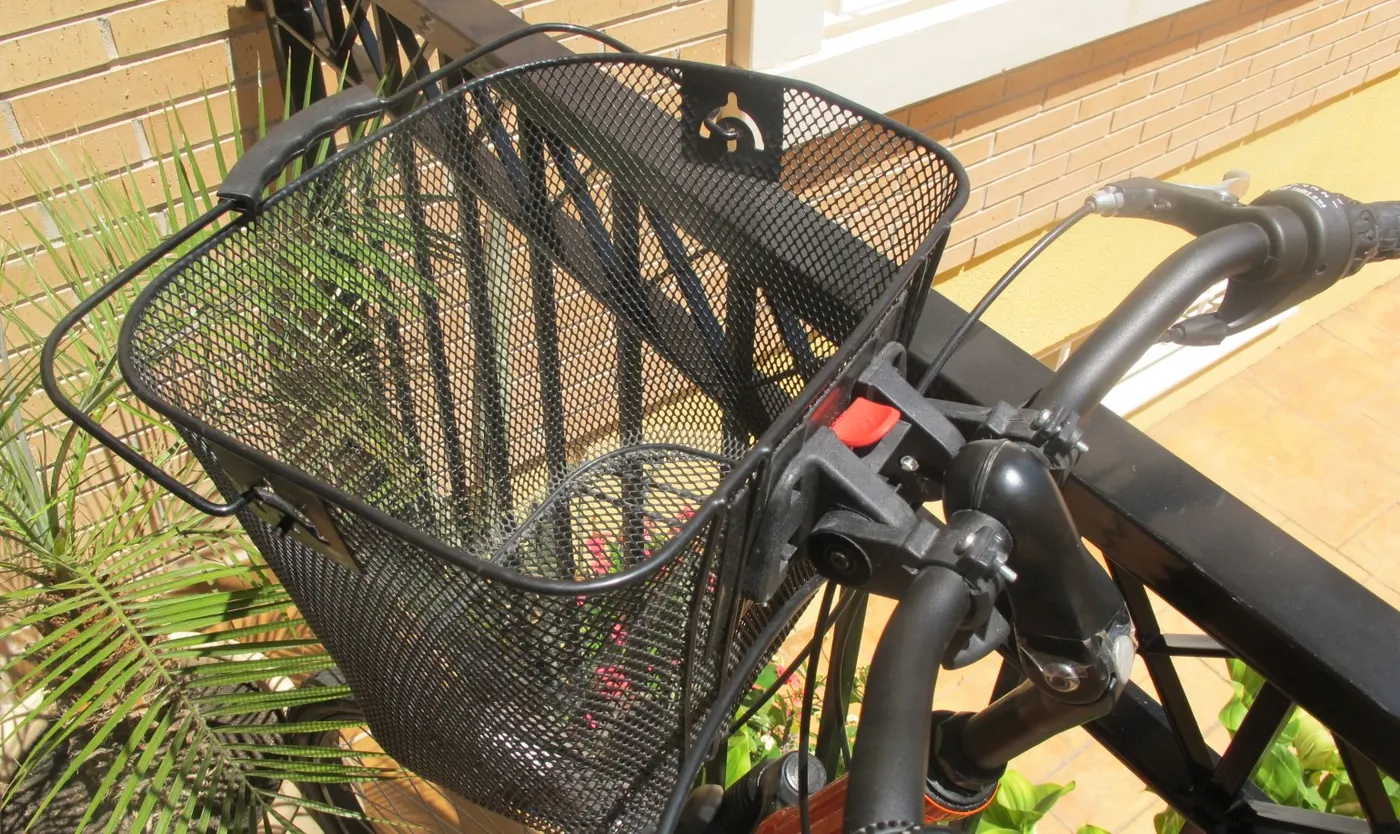
Loads alter both the total weight and its distribution. A basket capacity is a structural limit, not evidence that any arrangement within it will handle comfortably. A high, loose bag can shift during a turn. A heavy object on one side can make the vehicle feel uneven before you reach a sloping road.
Keep approved cargo low, restrained, and arranged according to the manufacturer. Preserve visibility of lights and access to controls. After adding an unfamiliar load, repeat a short level practice loop before using the street. Our cargo and grocery guide explains how to check the separate rider, basket, and total limits.
Consider an illustrative trip with bottles stacked above a rear basket. The weight might be below the printed basket limit, yet the stack can move or raise the load's center. Repacking into lower, secure bags or making two trips can be the better decision. Do not interpret unused capacity as a target to fill.
An electric tricycle may add assistance when the pedals move or a throttle is operated. The onset and continuation of that assistance vary by system. Learn the controls on level ground before adding a bend, incline, or confined entrance. Select the maker's recommended beginner mode and keep fingers able to reach the brakes.
Do not use extra power to overcome discomfort with a cross-slope. The motor can reduce pedaling effort while increasing the speed at which the handling problem arrives. If you are uncertain about a narrow turn, stop and plan the maneuver. Switch assistance off as instructed before walking or repositioning the vehicle.
Practice moving away, slowing, and stopping in each mode you expect to use. Notice whether a pedal movement while waiting can activate assistance. Do not bypass brake cutoffs or alter controller settings to make the tricycle feel more powerful. The pedal-assist and throttle guide explains how to build a control map without assuming every system works alike.
A driveway entrance can combine a turn, a slope, a drainage dip, and traffic coming from behind. Treat these as separate demands when planning the approach. If the entry gives you too little space to straighten the wheels before the surface change, a different access point may be more suitable.
Before entering, establish where you can stop without blocking traffic or placing one wheel on an unstable edge. Look for the exit as well as the entrance. A seemingly easy downhill entry may create a difficult uphill departure with a basket load. Scout the return maneuver during the same inspection.
Avoid repeated experiments in live traffic. Practice a similar shape in a controlled area first, then evaluate whether the real location offers adequate room and visibility. A helper can observe clearance from a safe position, but cannot make an unsuitable road layout safe. Document difficult entrances as route restrictions rather than personal failures.
| Situation | Useful first action | Reason to stop or reroute |
|---|---|---|
| Mild continuous cross-slope | Slow before the section and assess all wheel paths | Correction is uncomfortable or clear width is inadequate |
| Pothole near the outside wheel | Choose a clear corridor while still on the approach | Avoiding it would force a sudden turn or traffic conflict |
| Sloping driveway with tight gate | Inspect the whole maneuver on foot | Entry, stopping area, or return exit cannot be controlled |
| Pull on level ground | Check basic condition and arrange inspection | Binding, strong drag, wobble, or repeatable unexplained pull |
| New shopping load | Repack and test on level ground | Cargo moves, visibility is blocked, or control changes markedly |
Use this table as a planning aid, not a pass/fail engineering standard. A rider's reach, strength, and familiarity matter, as do the exact tricycle and weather. The right response can change after fatigue or rain. A route that worked yesterday is still worth reading today.
After practice, write down the location, surface, load, assistance mode, and maneuver that felt difficult. Avoid entries such as “bad at turning,” which offer no next step. “The right rear wheel approaches the curb during this left entry” identifies a clearance problem you can investigate.
Change one manageable factor at a time. First use a wider arc on level ground. Later add a familiar light load, if permitted. Do not simultaneously shorten the turn, increase speed, and add assistance. If a mechanical correction is made, restart with the simple exercise so you can tell whether the behavior changed.
The goal is predictable control with room to spare. Confidence should come from repeatable, uneventful maneuvers, not from surviving a corner that nearly lifted a wheel. Keep a route alternative ready and return to basic practice after a long break or a significant change to the tricycle.

Imagine an ordinary trip where the outward ride is empty and the return includes two secured grocery bags. The route ends at a driveway with a shallow drainage dip and a turn into a gate. The outward trip tells you little about how the loaded return will feel. Evaluate the entrance unloaded first, then with a modest familiar load within every applicable limit in a controlled setting. Do not use the first large shopping trip as the experiment.
Break the maneuver into approach, slowing, turning, crossing the surface transition, and stopping. Identify where each wheel will go and where the tricycle can stop if the gate is closed. If the only stopping place leaves a rear wheel at the pavement edge, the route has a planning problem. It should not be solved by approaching faster to avoid stopping.
You might choose to unload at a level permitted parking point before entering, use another gate, or ask the property owner about a suitable access change. Those options address the real task. Moving the saddle or adding a differential does not automatically fix an entrance that combines insufficient space with a cross-slope. Keep the observations in your route note so another household rider understands the restriction.
An experienced bicycle rider may try to lean and steer in a familiar pattern when the tricycle feels unusual. That instinct can lead to a sharp input instead of an early reduction in speed. Treat tricycle learning as a new control task, even if you have ridden bicycles for decades. Experience helps with observation, but it does not make every handling habit transferable.
Practice broad turns in both directions and notice whether one feels harder because of the surface, control reach, or your posture. Keep the vehicle and load unchanged while making that comparison. Do not conclude that one direction is inherently unsafe from a single trial on an uneven lot. Change to a suitable level location before attributing the difference to the tricycle.
If an instructor is available, ask them to observe the sequence rather than simply follow you on another vehicle. Useful feedback identifies when speed reduction happens, where your eyes go, and whether the rear wheel corridor stays clear. A professional can also recognize when the vehicle needs inspection before more instruction. The desired result is an uncomplicated maneuver that you can repeat comfortably, including on the return when you are tired.
If you stop on a slope, use the model's instructions for securing and repositioning the tricycle. Do not stand beside it and assume the parking brake can hold any gradient or load. Where the situation cannot be controlled, keep yourself clear of the vehicle's possible movement and arrange appropriate help. An unsuitable stop should become a reason to revise the route before the next trip.
A recovery plan can include a broad nearby stopping area, a person able to assist within the approved handling method, or transport arranged for the vehicle. It should not depend on lifting the whole tricycle by the basket or pushing it while the motor is active. Planning that alternative makes it easier to abandon a difficult section early, while there is still room to act calmly.
Research-based editorial guide; no hands-on stability testing was performed. The planning examples and practice sequence are our synthesis, not a manufacturer certification or a substitute for the instructions supplied with your tricycle.
Guide
Choose your first adult tricycle by checking rider fit, storage, weight limits, gears, brakes, assembly, and service before buying.

Guide
Learn how to compare adult electric tricycles for control, fit, batteries, braking, transport, and ownership support.

Guide
Understand the leg and hip muscles used when pedaling a tricycle, plus how fit, resistance, and electric assistance change the effort.