



Guide
First Adult Tricycle Buying Guide
Choose your first adult tricycle by checking rider fit, storage, weight limits, gears, brakes, assembly, and service before buying.
We research everything we recommend. When you buy through our links, we may earn a commission. Learn more
Guide
Choose and mount a tricycle bell or horn with control access, local requirements, courteous passing, condition checks, and realistic warning limits.

Updated · 12 min read
A bell or horn can announce a tricycle's presence, but sound does not create space or guarantee that another person hears and understands it. Choose an appropriate device around the rider's reach, the actual mounting point, and the route's current requirements. Keep predictable movement, observation, and room to stop central to the interaction.
This guide explains compatibility and ordinary use without ranking products by a claimed loudness figure. It does not provide a universal legal equipment rule or certify audibility at a distance. Check the exact vehicle, device instructions, and relevant local authority before purchase.
You may want to announce presence on a shared path, alert another cyclist before a permitted pass, or satisfy a local equipment requirement. These uses are related but not identical. A device chosen only because its sales page claims high output can be inappropriate for the ordinary route.
Record the conditions in which you expect to use it: traffic, pedestrians, group riding, gloves, and seating position. A low recumbent and an upright tricycle can have different control reach and bar geometry.
Do not choose sound equipment to compensate for an unsuitable route or a habit of passing closely. The safe-riding guide covers predictable control and stopping. Sound should support that routine rather than replace it.
Ask the relevant authority about the exact vehicle and route if equipment rules are unclear. A requirement for a bell may not mean any electronic horn is an equivalent replacement. Rules can differ between roads, paths, jurisdictions, and electric categories.
Use manufacturer equipment references as context, not universal law. AZUB's guide notes that required equipment can vary by country and configuration. A device supplied with a tricycle does not automatically establish compliance everywhere it may be ridden.
Keep material answers and their date with the route record. This article does not provide a legal opinion or an international equipment checklist. The practical purchasing task includes resolving the applicable requirement.
A mechanical bell uses a hand-operated mechanism and has no charging requirement, but it still needs sound mounting and condition. A powered device can add batteries, buttons, wires, or a separate charging process. The convenience depends on the actual product.
Ask how activation works and whether the rider can use it without losing control. A loud device with an awkward button may be less practical than a simpler suitable bell. Do not assume every thumb lever fits every grip arrangement.
If the device connects to the tricycle's electrical system, obtain explicit exact-model approval. A matching plug is not enough. The accessory guide distinguishes ordinary mounting from electrical compatibility.
Confirm the clamp diameter, shape, straight length, and permitted materials. Include any approved spacer or adapter. A product labeled universal can still interfere with an unusual handlebar or recumbent steering handle.
Check existing brake levers, shifters, throttle, mirror, and phone mount. Do not fill the only comfortable grip space because the clamp technically fits. The rider's hand needs a normal control position.
Use the device's fastening instructions and repeat the steering and brake checks. If the hardware cannot be installed without unapproved modification or control relocation, choose another suitable arrangement.

Sit in the normal fitted position and wear expected gloves and clothing. Check whether activation is manageable while preserving a secure grip and access to brakes. A stationary standing reach test can miss the seated relationship.
On a recumbent, steering orientation can change the comfortable finger movement. Use the actual vehicle during a trial where possible. Do not turn a control layout from a conventional bicycle into a universal recommendation.
The fit guide provides the broader control assessment. A bell that is difficult to operate may call for another approved position or device, not a compromised braking posture.
Check the mount through the manufacturer's permitted steering range. Ensure it does not press a lever, throttle, cable, or hose or collide with a basket. A device that works straight ahead can be obstructive during a turn.
For a wired button, follow routing instructions and preserve required movement. Do not tie wiring to a brake hose in a way that pulls it or use an improvised electrical splice. Seek qualified installation where the setup exceeds owner scope.
The brake guide explains the functions that must remain clear. Sound equipment is a poor trade if it reduces the rider's ability to stop.
Read how an output claim was measured, if that information is provided. Distance, direction, surroundings, and the device's condition can influence audibility. A large number in a listing should not be converted into a guaranteed communication range.
A stationary function check can confirm that the device operates, but it is not an acoustic laboratory test. Do not stage close loud demonstrations around people or animals to prove the claim. Follow product instructions and use suitable settings.
The useful comparison is whether the device meets the applicable requirement and can be operated appropriately by the rider. More output is not automatically a better shared-path interaction.
When appropriate and permitted, announce presence with enough time for the other person to react without surprise. Maintain a controllable pace and observe their actual movement. A sound does not prove that they heard, identified the tricycle, or will move as expected.
Use a courteous voice where suitable and do not assume sound is the only way to communicate. Some people may not hear you or may be focused elsewhere. Slow, wait, and choose a broad place rather than interpreting no response as permission for a close pass.
The commuting guide helps plan routes and times that reduce repeated difficult interactions. Equipment should make a suitable routine easier, not justify a poor one.
Follow the appropriate observation, signaling, and road rules for the location. A sound can announce presence without explaining your intended line. A mirror provides another information source but does not notify the person ahead of a turn.
The mirror guide covers brief observation and direct checks. Do not watch a reflected vehicle continuously while sounding a horn and neglect the surface ahead.
If the traffic or path interaction exceeds comfortable control, stop in a suitable place and revise the route or seek local instruction. Sound equipment cannot resolve every conflict.

Check the normal loaded configuration. A front bag or basket cover can block the activation lever or press a button unexpectedly. A mirror or phone mount adjusted later can also change reach.
The basket-bag guide explains fastening and envelope checks. Repack or use another approved arrangement if the communication device becomes inaccessible.
Do not operate the device by taking a hand far away from essential controls or reaching into cargo while moving. Stop to resolve the setup problem. The accessory should remain usable in the ordinary routine, not only with an empty vehicle.
Read battery, charging, weather, and indicator instructions. Do not assume the device is ready because the tricycle's main battery is charged. A separate unit may have another power state or required inspection.
If wired into the vehicle, use the approved system and service path. The battery-care guide provides wider electrical boundaries but does not authorize an accessory connection.
Keep any charging routine identifiable and avoid substituting a similar-looking charger or cable when approval matters. Resolve faults before relying on the device to meet a required equipment function.
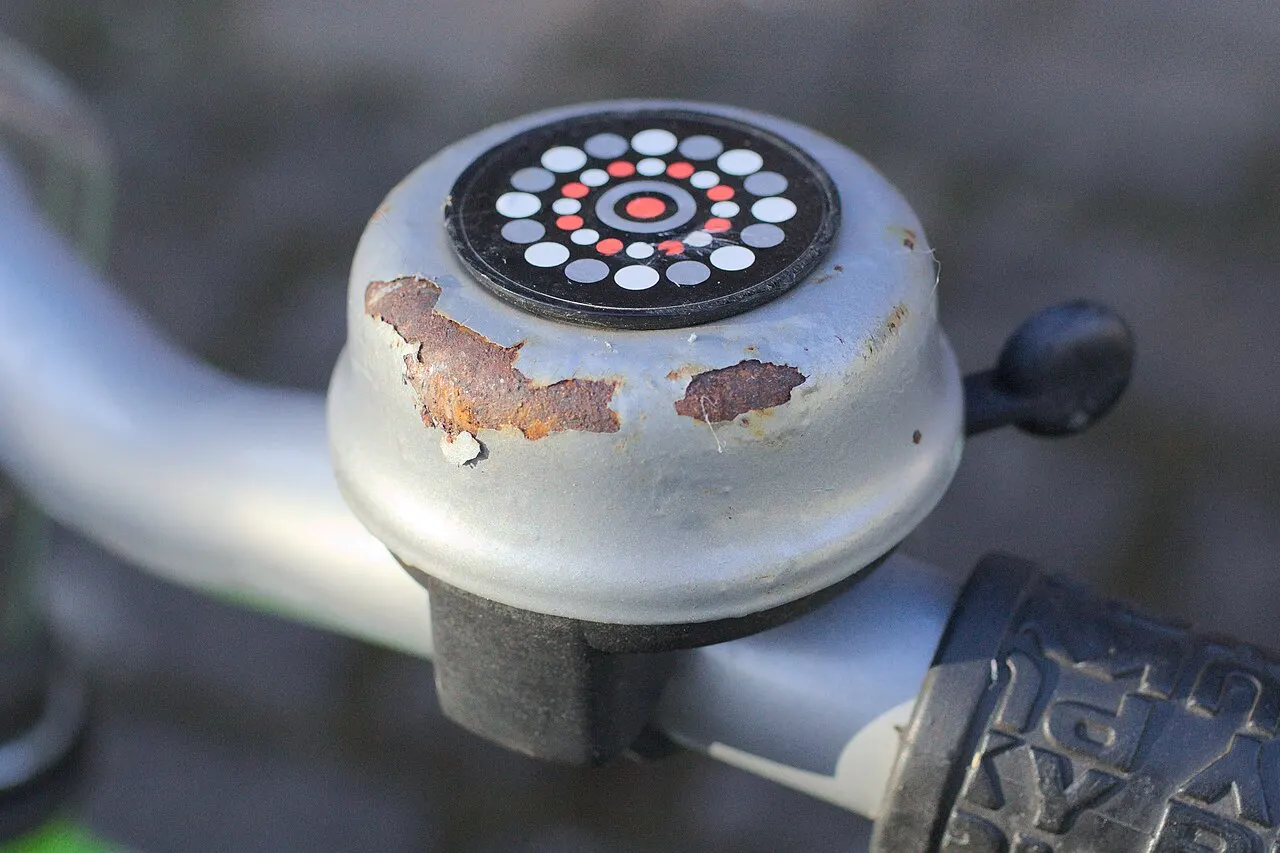
Check the mount, activation, casing, and moving parts as the maker directs. Corrosion, damage, or a stiff mechanism can change operation. A rusty bell photograph illustrates why condition is a separate question from product category.
Clean and dry using approved methods and avoid spraying lubricant indiscriminately around brakes or controls. The corrosion guide addresses exposure without prescribing a chemical for every device.
If the device no longer works reliably, obtain the permitted repair or replacement. Do not assume a faint or intermittent sound satisfies a local requirement; check the actual condition and applicable guidance.

Confirm whether the device remains fitted during folding or loading. A small bell can still strike a frame or be pushed against a control. Use the folding guide to include it in the complete sequence.
After transport, check position and function before riding. A shifted clamp can make the activation awkward even without visible damage. Do not rely on a setting that was correct before the vehicle was loaded.
For a shared tricycle, reset reach with the rider's permitted fit. One person's comfortable thumb position may not work for another. Keep the adjustment and installation instructions available rather than moving hardware by guesswork.
| Area | What to confirm |
|---|---|
| Task and rules | Ordinary use and applicable equipment requirement |
| Mount | Exact clamp fit and approved material/location |
| Reach | Normal seated posture, gloves, and secure grip |
| Clearance | Steering, brakes, throttle, wires, and cargo |
| Operation | Reliable activation without a guaranteed-range claim |
| Routine | Power, care, folding, transport, and shared use |
The practical choice is a suitable device the rider can use courteously and consistently. Do not choose from loudness alone or describe it as a guarantee that others will yield.
Think about the places where you usually need to announce your presence. On a shared path, the listener may be walking, talking, using headphones, or guiding a dog. In traffic, vehicle noise and separation create a different situation. A seller's loudness claim does not establish that a signal will be heard or interpreted in either setting. The device is one communication aid alongside speed choice, observation, positioning, and the decision to wait.
Distinguish being noticed from obtaining a clear route. A person may hear a bell and move unpredictably, look behind them, or stop. Another may not react at all. Leave sufficient room and time to respond rather than treating a sound as a command to move. If the path remains obstructed, slow or stop as appropriate. The goal is a predictable encounter, not demonstrating that a particular accessory has enough volume to compel a response.
Consider your own ability to operate the device comfortably. An upright trike and a recumbent can place the controls in different locations, and gloves or a limited hand movement can change practical reach. Evaluate operation while stationary in the normal riding position. A bell that is audible but requires an awkward reach or interrupts access to a brake may be a poor choice for that installation. Seek an approved alternative location or device rather than accepting the interference.
Rules for signaling equipment vary by place and vehicle classification. Determine which official local requirement applies to the exact trike and route, especially for an electric model. Read whether it specifies a bell, another audible warning device, or a particular condition. Do not assume that a horn automatically satisfies a bell requirement, or that a device sold online is permitted simply because it is marketed for bicycles.
Save the relevant official reference with your equipment notes when compliance affects the purchase. If the wording is unclear for a particular electric tricycle, ask the appropriate local authority or obtain qualified local advice. A discussion board can point toward an issue, but it is not the authoritative rule. This guide uses general bicycle safety guidance for preparation and observation; it does not claim to have resolved signaling laws for every city or country.
Recheck when your riding location or vehicle changes. A touring destination, a park-operated path, and an ordinary street can have different operating rules. Some private facilities may impose conditions beyond public-road equipment requirements. Read their posted instructions before riding. Avoid turning one local answer into a site-wide claim that every adult trike needs the same device or may use the same type of horn everywhere.
Identify the intended clamp surface and its permitted diameter, material, and shape. A round handlebar fitting may not suit an unusual recumbent control tube, and a mount can overlap other accessories even when its diameter is correct. Include mirror clamps, lights, display units, shifters, cables, and the full range of steering movement in the assessment. The available space is the space that remains clear in normal operation, not just the unused area visible in a parked photograph.
Follow the mounting instructions for pads, hardware, positioning, and tightening. Do not add an arbitrary screw or force a small clamp around a larger surface. If the device needs a specified adapter, use the approved part and confirm compatibility. A loose bell can rotate toward a lever or cable; an excessively tightened clamp can damage the mounting surface. Neither outcome is corrected by assuming that a low-cost accessory deserves less careful installation.
After fitting, check access while stationary and secure. Operate the intended lever, button, or thumb control without disturbing other controls. Perform the steering and cable-clearance checks required by the trike and accessory instructions. If the signal fails to operate reliably or the mount shifts, correct the cause before riding. Keep any required battery care or weather-exposure instructions with the device rather than inferring that every handlebar accessory tolerates the same conditions.
Observe the path ahead early enough to avoid a last-second signal. Choose a speed that lets you respond if the person does not hear, if an animal moves, or if the available width is smaller than expected. A three-wheel vehicle may need more clearance than the listener anticipates. Announce your presence through the appropriate local practice, then assess the actual response and space. Do not accelerate into an unresolved gap because the bell has already been used.
When words are useful, keep them brief and calm. Local conventions differ, so avoid assuming that one phrase or one side of passing is universal. The most useful information is that you are approaching and will wait until there is room. If the other person seems uncertain, leave more time instead of repeating an increasingly urgent signal. A patient stop can be the safest outcome when the route, width, or response remains unclear.
Review the encounter afterward only when stopped. If you repeatedly struggle to reach the bell or signal too late, adjust the approved setup or route routine before the next outing. If the device is damaged or corroded, follow its service or replacement guidance. The rusty bell photograph in this article illustrates condition inspection; it is not an endorsement of that product or proof of its sound. A useful warning device supports a considerate riding habit and remains subordinate to observation and control.
Research-based guide; no acoustic measurements, audibility trials, or legal equipment assessment was performed.
Guide
Choose your first adult tricycle by checking rider fit, storage, weight limits, gears, brakes, assembly, and service before buying.

Guide
Learn how to compare adult electric tricycles for control, fit, batteries, braking, transport, and ownership support.

Guide
Understand the leg and hip muscles used when pedaling a tricycle, plus how fit, resistance, and electric assistance change the effort.