
Guide
First Adult Tricycle Buying Guide
Choose your first adult tricycle by checking rider fit, storage, weight limits, gears, brakes, assembly, and service before buying.
We research everything we recommend. When you buy through our links, we may earn a commission. Learn more
Guide
Compare upright and recumbent adult tricycles by entry, support, pedal reach, handling, cargo, storage, and real ownership needs.

Updated · 12 min read
Choose between upright and recumbent adult tricycles by testing the tasks you will perform, not by assuming one riding position is universally healthier or safer. An upright machine usually places the saddle above the pedals, while a recumbent provides a supported seat with pedals farther forward. Those layouts change entry, reach, visibility, storage, and handling. The best match is the particular vehicle whose complete arrangement works for your body and route.
This guide compares configurations rather than ranking models. It is based on published information and practical decision analysis, not our own test rides or clinical research. It does not prescribe a seat angle or recommend a design for a diagnosis. Riders with pain, mobility limitations, or postoperative restrictions should have the proposed activity and setup assessed by an appropriate professional.

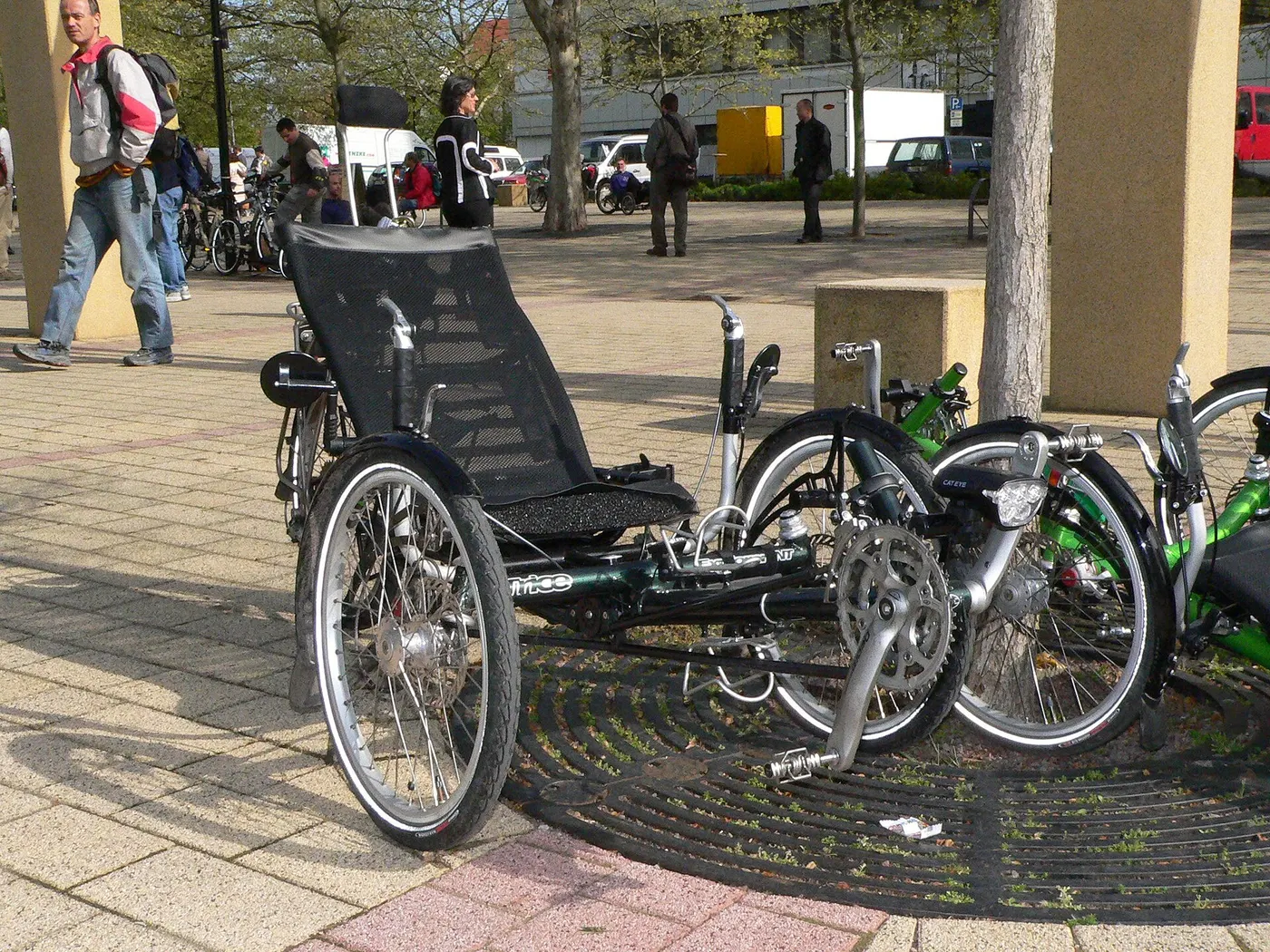
Upright and recumbent describe the rider's position. Delta and tadpole describe the wheel arrangement: one front and two rear wheels, or two front and one rear wheel. A recumbent can be a delta or a tadpole. Folding and electric assistance are additional features, not alternative posture categories.
Separating these descriptions prevents a misleading comparison. A low recumbent tadpole and a higher recumbent delta may have different transfer and storage requirements despite sharing a supported seat. Likewise, an upright electric model can have different control and weight characteristics from a manual upright machine.
Write the complete configuration beside each candidate. Include the seat layout, wheel arrangement, drive system, and folding capability. Compare those actual combinations rather than treating all recumbents as one machine. Our first-tricycle shopping guide puts these design questions into a wider purchase workflow.
A riding position can feel comfortable once you are seated while remaining difficult to access. Try mounting and dismounting before judging the padding. Low recumbent seats can ask for a different transfer from a higher upright saddle. Neither height is automatically easier for every rider.
Use the prescribed parking procedure and suitable assistance during the trial. Identify approved handholds and where your feet move. Do not step on a basket or steering component to solve an awkward transfer. The available handholds, pedal position, and frame shape deserve as much attention as a headline step-through measurement.
Repeat the exit movement after a short trial rather than testing only entry while fresh. Think about normal clothing, footwear, and any mobility aid. A family member's ability to lift or steady the machine should be part of an agreed plan, not an assumption that makes an unsuitable vehicle appear independently usable.
On an upright, the saddle supports the pelvis and the hands interact with the handlebar. On a recumbent, the seat and backrest distribute contact differently. The precise experience depends on shape, recline, reach, and adjustment. A photograph of a comfortable-looking seat does not establish the fit for you.
Check whether the backrest remains useful with your hands on the controls. If you must lean away from it to steer or brake, the supported position is not being used as intended. Conversely, a relaxed upright arrangement should not require constant stretching or locked elbows simply to maintain control.
ICE's seating options illustrate the variety within recumbent designs, including different support arrangements. That variety is a reason to evaluate the actual seat, not proof that one brand or posture resolves pain. Ask what can be adjusted and what the approved limits are before imagining a perfect future setup.

Turn the pedals through a comfortable revolution in the intended position. Observe whether the rider reaches, rocks the hips, or encounters a cramped point. Saddle height on an upright and seat-to-pedal distance on a recumbent are different adjustment questions. A setting from one design does not transfer as a simple number to the other.
Crank length, footwear, and the position of the pelvis affect the movement too. Avoid universal claims that one posture always puts every knee in a favorable angle. A published angle from a single example should not be assigned to all machines or all riders. Fit needs to be assessed across the complete motion.
Our adult tricycle sizing guide explains the measurement process. If a movement causes persistent symptoms, seek an assessment rather than selecting a design based on an internet promise of joint relief. Comfort is important evidence from a trial, but it is not a diagnosis.
Upright bars are commonly in front of the rider, while recumbent controls may sit beside or below the seat depending on the design. Both arrangements vary. Ask how steering and braking work, then check whether the hands can remain securely placed without tension or excessive reach.
A familiar-looking handlebar can conceal an awkward position. An unfamiliar recumbent control can be comfortable after instruction, but should not be assumed suitable without trying it. Learn the actual range of movement and how the controls behave through a broad turn in a controlled area.
For riders needing adapted controls, speak with a qualified supplier about approved options. Do not improvise extensions, restrict lever travel, or modify steering linkage to fit a preferred machine. The complete control system has to work predictably, not merely feel reachable while parked.
A higher seat and a lower seat provide different sightlines. Try looking ahead, checking surrounding space, and reading necessary controls. Vehicle shape, mirrors, baskets, and your own posture can affect the view. A general statement that upright means visible or recumbent means invisible is too simple.
Think about the actual environment. Parked vehicles, hedges, path barriers, and crossings can limit sightlines independently of the tricycle. A low configuration may require particular attention to how others can notice it. Flags, lights, and reflective equipment can help, but do not make every route appropriate.
Evaluate visibility equipment in the configured vehicle. A mirror must not obstruct another control, and luggage should not cover a light. Keep the rider's view and other road users' view as separate questions. You need to observe the route and be conspicuous enough for the circumstances.

Both configurations can support themselves without the balancing technique of a two-wheel bicycle at a stop. That benefit does not establish cornering limits. Seat height, track width, geometry, load, surface, and speed interact. A low seat does not make a non-tilting tricycle impossible to overturn.
Ask for model-specific operating guidance rather than a universal technique based on the category name. Begin with broad, slow turns and a suitable practice area. Do not attempt to discover the tipping threshold or copy a fast demonstration by an experienced rider. The objective is predictable ordinary control.
Our safe riding guide explains starts, stops, width, slopes, and route progression. Use it alongside the actual manual. Neither a supported seat nor three wheels should be treated as permission to skip familiarization, especially on an electric model.
Record assembled length, width, height, and clearance for the exact vehicle. A recumbent may be long, an upright may have a wide basket, and a folding feature may reduce one dimension but not another. Do not infer the complete footprint from wheel size or the posture label.
Measure gates and the approach to them. A long vehicle can fit through an opening when aligned but lack room to make the approach turn. A wide wheel pair can clear differently from the wheel at the other end. Evaluate the complete access journey rather than only the parking rectangle.
If possible, use a measured footprint mock-up and a retailer demonstration. Include room for your body while moving the vehicle. Our storage and transport guide develops that process. A design that looks compact in a photograph can still be inconvenient in a real hallway.
Upright tricycles often feature rear baskets, but the presence of a basket does not establish its capacity or suitability for every errand. Recumbents can also support approved cargo systems. Check the actual mounting arrangement, total payload, rider limit, and separate rack or basket limits.
Think about how you will reach the load at the destination. A convenient riding position may leave the basket awkward to access while parked. If you need to bend, lift, or remove a bag, include that task in the trial. Groceries still have to be carried from the vehicle into the home.
Avoid hanging additional bags from the controls to compensate for inadequate cargo space. Choose an approved arrangement and secure the load. Our grocery and cargo guide examines those decisions in detail, including why a large basket is not a passenger seat.
A motor can change the workload on either posture. It does not change every physical interaction with the seat or controls. Comparing a powerful electric recumbent with a manual upright can confuse assistance benefits with posture benefits. Try to separate those variables in your notes.
Ask which aspect produced the improvement you noticed. Was starting easier because of assistance? Was pressure more comfortable because of the seat? Was entry easier because of frame height? A clear answer helps you choose the features you need rather than buying a category because one example felt appealing.
Our electric tricycle guide covers sensors, batteries, and control response. Check those systems independently of posture. Added weight also affects storage and recovery, so an assisted vehicle needs a realistic plan for handling it off the road.
Neither layout should be assigned universal off-road capability. Tire type, frame clearance, suspension, and component design matter. A low position may make particular obstacles more relevant, while an upright machine has its own limitations on cross slopes and uneven ground. Use the actual intended-use guidance.
Look at the surface you will regularly encounter. A smooth route and a rough path ask different questions of the machine and rider. Do not select from a short test on perfect pavement and assume the same comfort elsewhere. Seek representative evidence within approved conditions.
If the route creates repeated awkward sections, reconsider the route as well as the vehicle. More padding or assistance does not necessarily solve poor clearance or an unsuitable camber. Practical access to an enjoyable ride can matter more than theoretically wider capability.
Find a shop that can service the proposed model and configuration. A supported-seat machine may use specialized steering or drivetrain parts. An upright can also have proprietary axle or electrical components. Do not assume every bicycle shop can handle every tricycle simply because familiar parts are visible.
Ask who performs initial fitting, assembly, and subsequent adjustment. A recumbent boom or seat setting can require related setup work. Avoid comparing a professionally configured example with an unadjusted alternative and calling the difference a universal property of the category.
Keep a record of approved settings and component identification. Our maintenance guide explains useful ownership records. Service availability is part of the match, especially when the vehicle is too large to transport conveniently to a distant specialist.

Record entry, pedal movement, control reach, support while steering, visibility, stopping confidence, width, cargo access, storage, and service. Keep observations descriptive rather than assigning an invented ergonomic score. A note such as “must lean away from backrest to brake” points to a concrete issue.
Mark essential conditions as pass, fail, or unverified. A machine with an attractive seat cannot compensate for a failed transfer or inaccessible controls. Do not average a safety-critical limitation away by awarding points for price and appearance. Resolve important unknowns before committing.
Try the ordinary sequence on both candidates where permitted: park, enter, start gently, stop, make a broad turn, park again, and exit. Use comparable setup and conditions. A different salesperson's enthusiasm or a faster motor demonstration should not determine the result.
A recumbent can feel more comfortable for one rider, and an upright can be more practical for another. Those observations do not prove one design cures back pain or is ideal after every operation. Advertisements often blend comfort, fitness, and rehabilitation into one claim; your decision should keep them separate.
If medical restrictions apply, show the actual machine and intended use to the treating professional. Explain transfers, route, control requirements, and any assistance. Permission for stationary exercise is not automatic clearance for outdoor riding on a similar-looking seat.
For that distinction, see our cycling and knee rehabilitation guide. It does not decide which tricycle to buy. It explains why clinical suitability requires more than identifying a posture that is widely described as comfortable.
The final choice should meet the rider's essential tasks with a realistic ownership arrangement. That can favor an upright, a recumbent delta, or a recumbent tadpole depending on the details. There is no need to declare a winner for everyone to make a confident personal decision.
Keep unresolved conditions explicit: a gate not yet measured, controls not yet tried, service not confirmed, or an adaptation not yet approved. Delay ordering if one of those can rule out the vehicle. A purchase is easier to change before delivery than after assembling a large machine.
Use the trial and worksheet to select the actual configuration that works. Posture is one meaningful feature, but its value comes from the complete relationship between rider, vehicle, route, and support. That is a stronger basis than a comparison chart that labels every recumbent comfortable and every upright unsuitable.
A rider interested in short shopping trips may begin with an upright because the basket arrangement looks familiar. The decisive checks are still entry, control reach, cargo access, parking, and the home gate. If the available model fails one of those, an upright label does not rescue it. A recumbent with an approved carrying system may deserve a trial rather than dismissal based on its recreational appearance.
A rider who wants supported seating for longer leisure outings may prefer a recumbent trial. Compare the actual backrest, pedal reach, steering, transfer, and sightlines. Do not infer that every supported seat uses the same recline or has the same entry height. The demonstration should include stopping and exit, not just resting comfortably while someone describes the features.
A household intending to share one vehicle needs a repeatable fitting process for both people. Ask which adjustments can be changed without workshop work and whether every person remains within the approved range. A machine that fits one rider after a complex setup may not be practical to reset for another before each outing. Confirm the sequence and keep each approved setting documented.
Across these cases, compare the task that actually limits use. It might be entering a low seat, reaching an upright bar, lifting the folded vehicle, or obtaining local service. The useful category is therefore the one whose particular configuration solves that limitation without creating an equally serious one elsewhere. A comparison table can organize the questions, but it cannot supply answers for a machine nobody has measured or a rider who has not tried it.
Guide
Choose your first adult tricycle by checking rider fit, storage, weight limits, gears, brakes, assembly, and service before buying.

Guide
Learn how to compare adult electric tricycles for control, fit, batteries, braking, transport, and ownership support.

Guide
Understand the leg and hip muscles used when pedaling a tricycle, plus how fit, resistance, and electric assistance change the effort.